北京科技大学侯新梅&杨涛&中国环境科学研究院王宏洋等:Ce诱导的动态电子缓冲作用, 用于调控Co在碱性氧析出反应中的可控表面重构
2026-10-08 14:32:02
作者:中国科学材料 来源:中国科学材料
分享至:
过渡金属氢氧化物被认为是极具潜力的析氧反应(OER)催化剂.
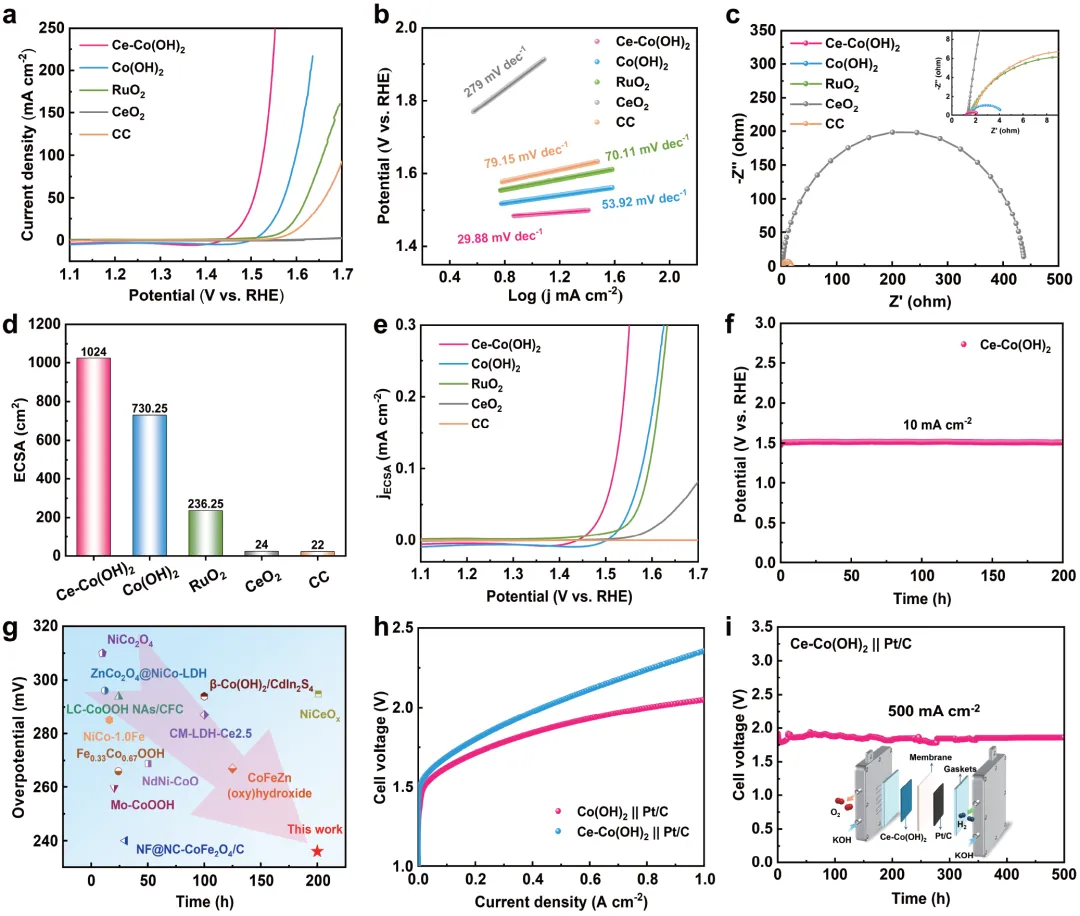
近日,北京科技大学侯新梅教授、杨涛教授和中国环境科学研究院王宏洋博士等在Science China Materials发表研究论文,通过一步电沉积法成功制备了Ce掺杂的Co(OH)2电催化剂。通过调节电沉积温度可以精确控制Ce3+/Ce4+的比例,从而影响OER反应动力学。
本文要点
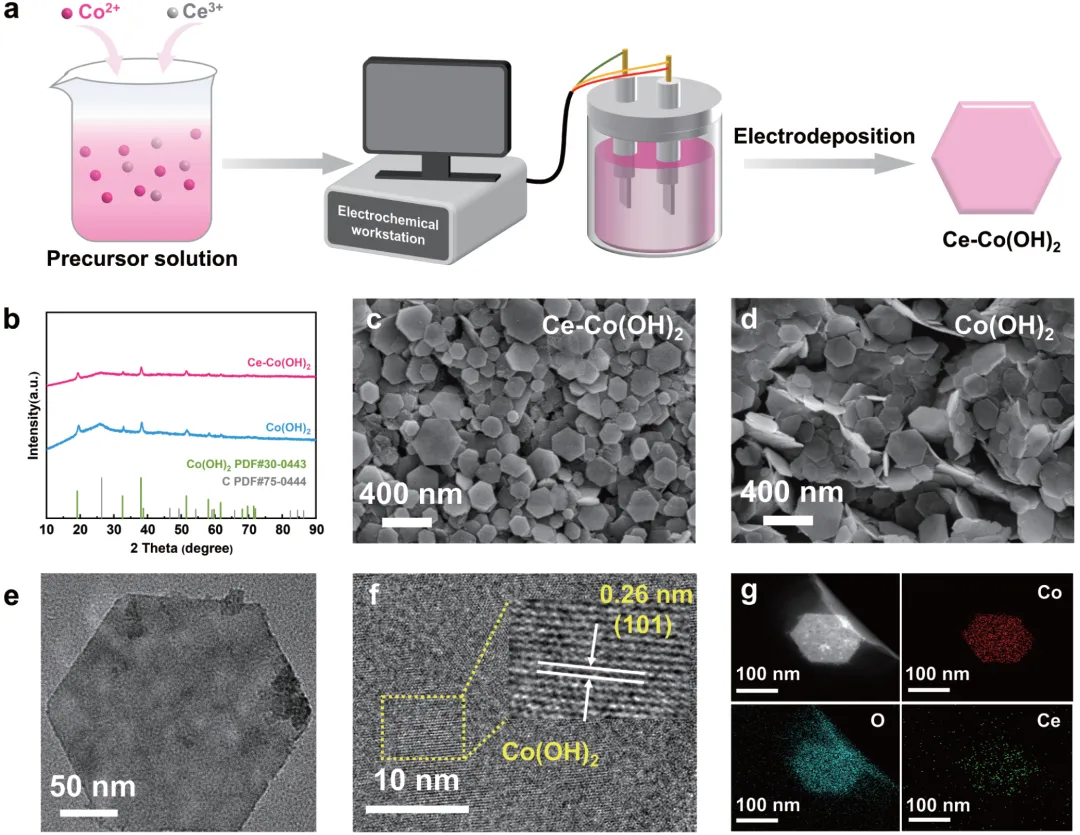
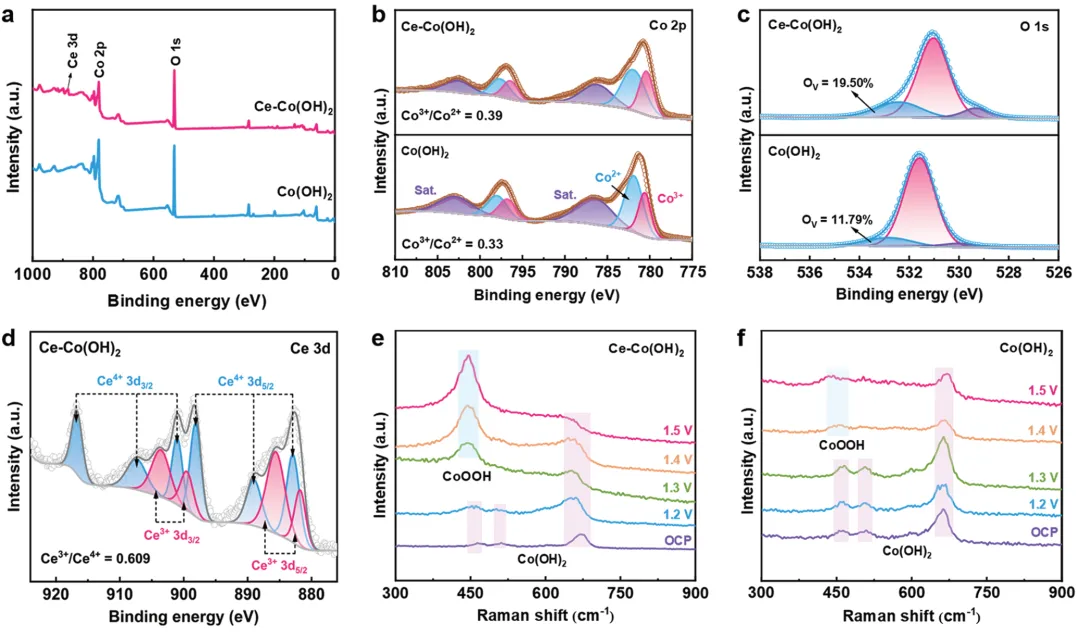
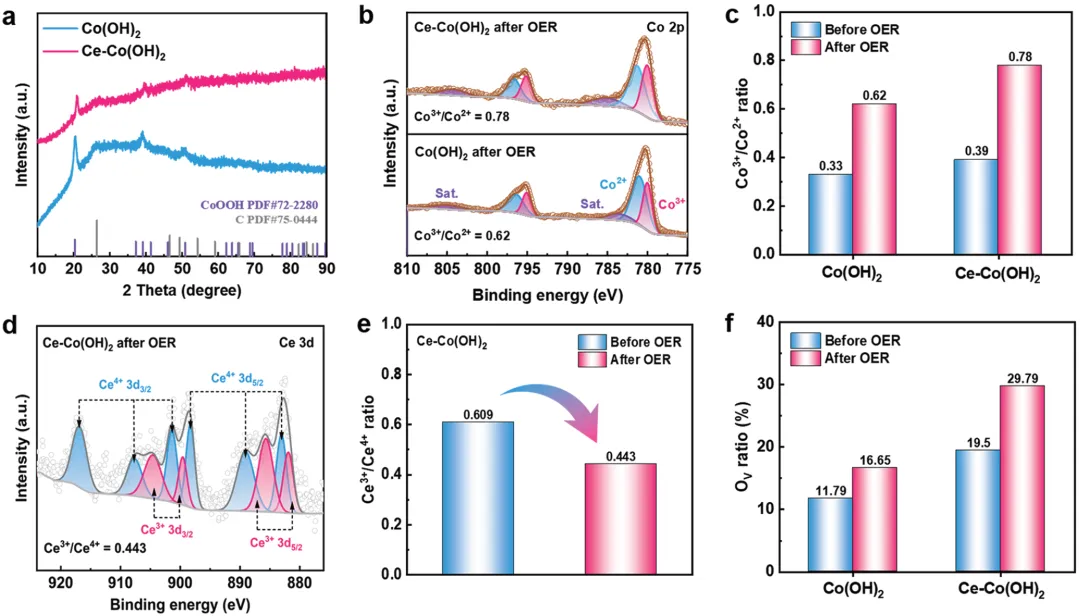
1) 优化后的Ce-Co(OH)2催化剂在10 mA cm−2下的过电位仅为236 mV,且具有超出200 h的长期稳定性。2) 将优化后的Ce-Co(OH)2阳极集成到阴离子交换膜电解槽(AEMWE)系统中,在1 A cm−2时表现出2.04 V的槽压,并且在500 mA cm−2时展现出超500 h的长期稳定性.该工作证明了Ce3+/Ce4+动态电子缓冲是调控表面重构的有效策略,为碱性水电解中高效催化剂的设计提供了一种创新策略。Figure 1. (a) Schematic illustration of the fabrication process for Ce-Co(OH)2. (b) XRD patterns of Ce-Co(OH)2 and Co(OH)2. SEM images of (c) Ce-Co(OH)2 and (d) Co(OH)2. (e) TEM image of Ce-Co(OH)2. (f) HRTEM image of Ce-Co(OH)2 showing lattice fringes. (g) TEM-EDS elemental mapping of Ce-Co(OH)2.Figure 2. (a) Total XPS spectra of Ce-Co(OH)2 and Co(OH)2. XPS spectra of (b) Co 2p and (c) O 1s in Ce-Co(OH)2 and Co(OH)2. (d) Ce 3d spectrum of Ce-Co(OH)2. In situ Raman spectra of (e) Ce-Co(OH)2 and (f) Co(OH)2.Figure 3. (a) LSV curves, (b) Tafel plots, (c) Nyquist plots according to EIS measurements with an enlarged view of the high-frequency region in the inset, (d) ECSA values, and (e) ECSA-normalized LSV curves of Ce-Co(OH)2, Co(OH)2, RuO2, CeO2, and CC. (f) Chronopotentiometric stability test of Ce-Co(OH)2 at 10 mA cm−2. (g) The overpotential and stability comparison between Ce-Co(OH)2 and recently reported Co-based OER catalysts at 10 mA cm−2. (h) AEMWE polarization curves of Ce-Co(OH)2 and Co(OH)2 in 1 M KOH at 80 °C. (i) Chronopotentiometry of AEMWE at 500 mA cm−2 with a schematic diagram of an AEMWE system in the inset.Figure 4. (a) XRD patterns of Ce-Co(OH)2 and Co(OH)2 after OER. (b) XPS spectra of Co 2p in Ce-Co(OH)2 and Co(OH)2 after OER. (c) Co3+/Co2+ ratio in Ce-Co(OH)2 and Co(OH)2 before and after OER. (d) Ce 3d spectra of Ce-Co(OH)2 after OER. (e) Ce3+/Ce4+ ratio in Ce-Co(OH)2 before and after OER. (f) OV ratio in Ce-Co(OH)2 and Co(OH)2 before and after OER.

Tao Yang (杨涛) received his BS degree in the School of Metallurgical Engineering from Anhui University of Technology in 2010 and his PhD degree in the State Key Laboratory of Advanced Metallurgy from the University of Science and Technology Beijing in 2018. He is now a professor at the Institute for Carbon Neutrality, University of Science and Technology Beijing. His current research mainly focuses on the field of electrocatalysis.
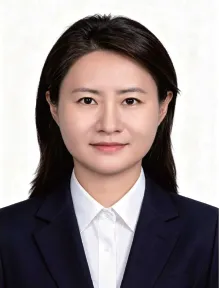
Hongyang Wang (王宏洋) received her MS degree in the Department of Environmental Science and Engineering from Tsinghua University in 2009, and her PhD degree in the Department of Environmental Engineering from Kyoto University in 2013. She is currently a senior engineer at the Chinese Research Academy of Environmental Sciences. Her main research focuses on development and application of functional materials.
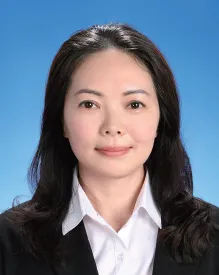
Xinmei Hou (侯新梅) received her BS and MS degrees from Zhengzhou University, and her PhD degree from the University of Science and Technology Beijing in 2009. She is now a full professor at the University of Science and Technology Beijing. Her research interests include the preparation of high-performance ceramics, high-temperature properties, and functional applications in the fields of electrochemistry and the environment.
免责声明:本网站所转载的文字、图片与视频资料版权归原创作者所有,如果涉及侵权,请第一时间联系本网删除。